Gloucestershire Village of the Year 2026 - Awards
Full list of prize-winners for Gloucestershire Village of the Year 2026
The results of our Gloucestershire Village of the Year 2026 competition were announced at the awards ceremony at Highnam Court on the evening of Thursday 16th July.
Congratulations to all the winners, runners-up and highly commended entries, and our thanks go to the competition sponsors, the judges, Highnam Court, and everyone else who contributed to the success of this annual competition which celebrates community life in Gloucestershire.
The overall winner receives a £2,000 prize, and the overall runner-up receives £1,000. In addition, within each category there is a £2,000 first prize, and a £1,000 runner-up prize - which makes £15,000 in total prize money! Winners and runners-up all receive plaques and certificates, with certificates going to any highly-commended entries.
Overall Winner - Gretton
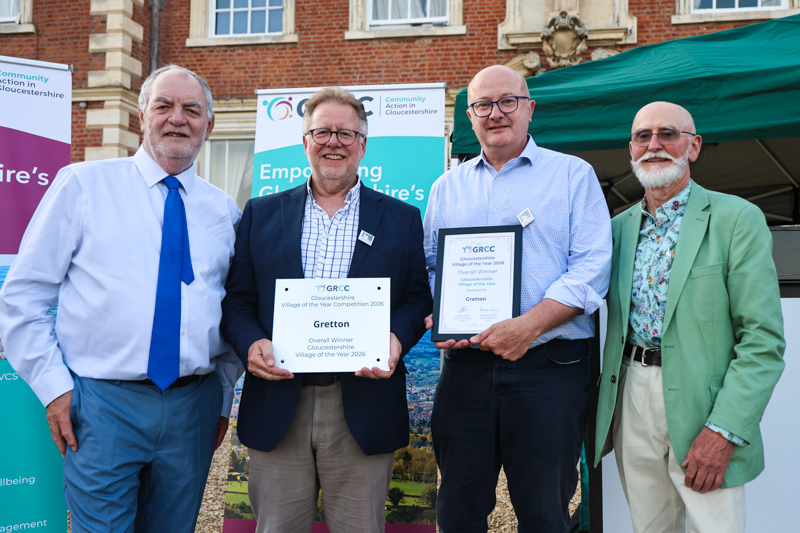
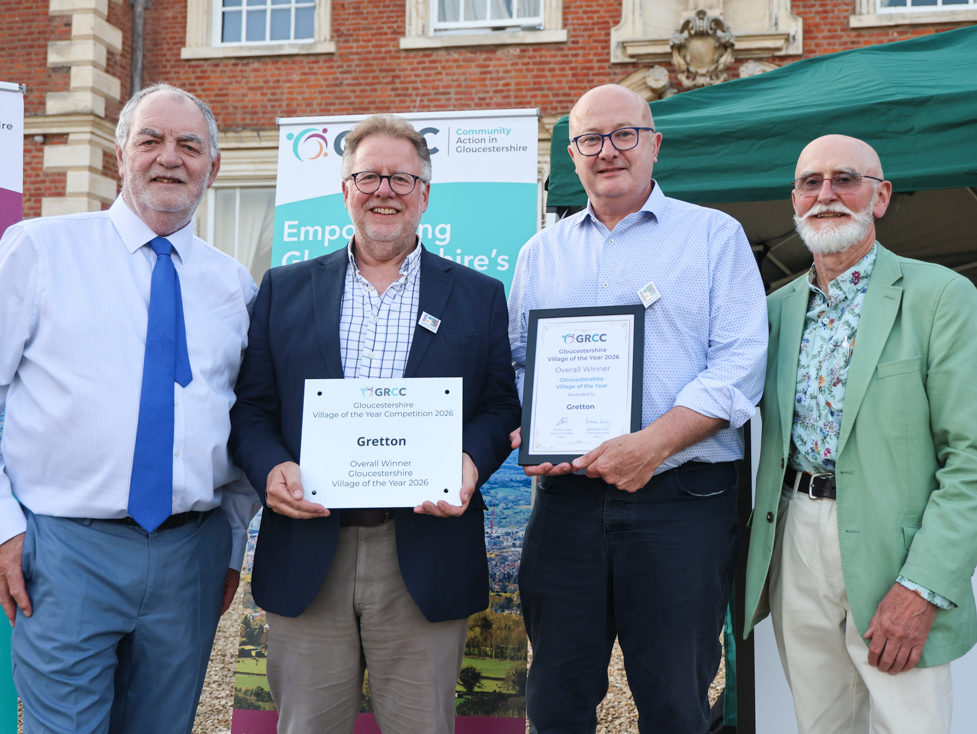
Photo above: left to right, Charles Coats, chair of GRCC's Board of Trustees, Mark Oliver, Gretton Village Association, Adam Wawn, Gretton Village Association, Duncan McGaw, Vice Chair of GRCC's Board of Trustees.
Our overall winner, Grettton, impressed the judges with a strong performance across the board, taking a proactive, solution-focused approach towards supporting health, wellbeing, social interaction, intergenerational connection, environmental action, volunteering, and use of digital technology to bring everything together. The community hub was established to reduce isolation amongst the older population; a WhatsApp help group and skills-sharing of professional expertise and practical trades supports others within the community; the village hall is a visible and effective demonstrator site for low carbon technologies; the Village Association has been rebuilt from a team with little support to an oversubscribed committee and a helpers group of around 35 to help with events and tasks. There are areas of rewilding, time dedicated to footpath maintenance, including replacing a footbridge over a stream to make it more accessible, recommended walking routes on the website and noticeboards, and fruit trees planted in the playing field, which is also host to a small Forest School.
On top of this, the judges were impressed by the strong culture of participation and share responsibility in evidence on their visit, along with practical plans for further development in all category areas, including for a new activity space at the rear of the Village Hall, an online historical archive, and introducing recycling facilities for batteries and a clothing bank.
Overall Runner-Up - Upton St Leonards
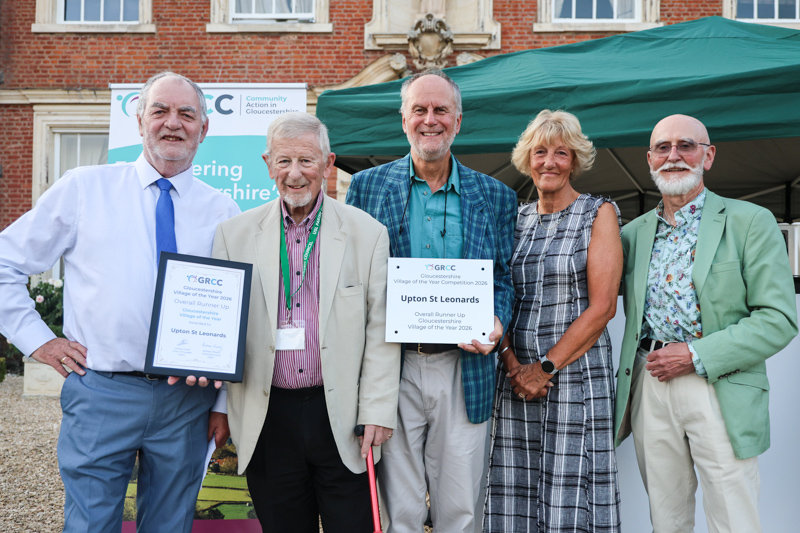
Photo above: left to right, Charles Coats, chair of GRCC's Board of Trustees, Cllr Keith Pearson, Cllr Cliff Alderman, and Chrissie Castle, representing Upton St Leonards, Duncan McGaw, Vice Chair of GRCC's Board of Trustees.
Upton St Leonards submitted a strong all-round entry, demonstrating a joined-up and inclusive approach to physical and mental wellbeing that cut across all categories. There is evidence of a wide range of clubs, societies, activities, with both formal and informal opportunities to get together. Particular care has been taken to ensure everyone is connected to village life, through the village newsletter, active Facebook community, local WhatsApp groups, with parish council staff and a local resident providing digital support and training to ensure everyone who needs help can get and stay connected too. Biodiversity and care for the village environment are central, notably the well-supported volunteer Footpaths group that provides gentle exercise as well as maintaining the village paths, and a range of hands-on activities and events that engage young people in environmental issues. The judges were especially impressed with the practical conservation work at the nature reserve, where work is being done to improve habitats and support the long-term reintroduction of the Duke of Burgundy butterfly.
During the judges’ visit they were particularly struck by how close-knit the village is, gaining a clear sense of how they look out for each other. There was justifiable sense of pride in place: the facilities, resources, and the way the people come together for activities and occasions to create a strong community and a vibrant place to live.
Category 1 Community-Led Health and Wellbeing, sponsored by the Royal Agricultural University
Health is important to all of us, and we each have an individual responsibility to maintain a healthy lifestyle. This category looked at what types of activities promote physical and / or mental health in our communities on a regular basis, and how our villages support everyone to stay healthy, active, and well.
Winner - Stinchcombe
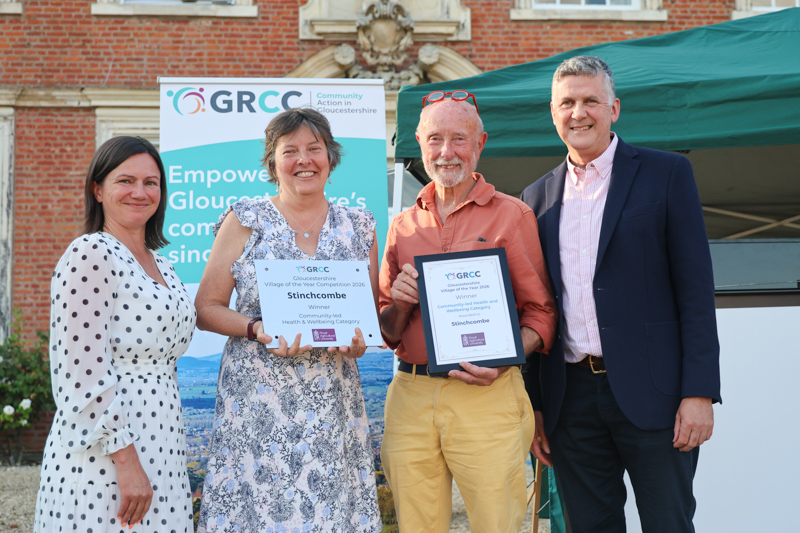
Photo above: left to right Hayley Coombs, Judge, Cllr Alison Wall and John Pinch, representing Stinchcombe, and Will Marsh, Judge.
Stinchcombe has made efforts to overcome challenges posed the local geography and lack of obvious community amenities or shop, by creating a strong and organised local network that keeps all residents engaged and involved through the village WhatsApp group, hand-delivered newsletter, and busy calendar of events. A number of groups and clubs encourage intergenerational involvement, including monthly meals at the rugby club, exercise and wellbeing classes at the village hall, coffee and social events at the church and the hall. The new playground, funded by raising £30,000 locally, demonstrates how the village comes together to identify and meet community needs, with the design, hedging, trees, benches, and bug castle indicating how it is intended to work both as a facility for the 80+ school-age children but also as a wider community space.
The judges were impressed with the ways in which the community appears to compensate for the lack of community amenities and the pattern evidenced of people creating reasons to meet and support each other, tackling isolation through practical connection rather than formal services, and making plans for future activities and events to continue to support both physical and mental wellbeing.
Runner-up - Berry Hill
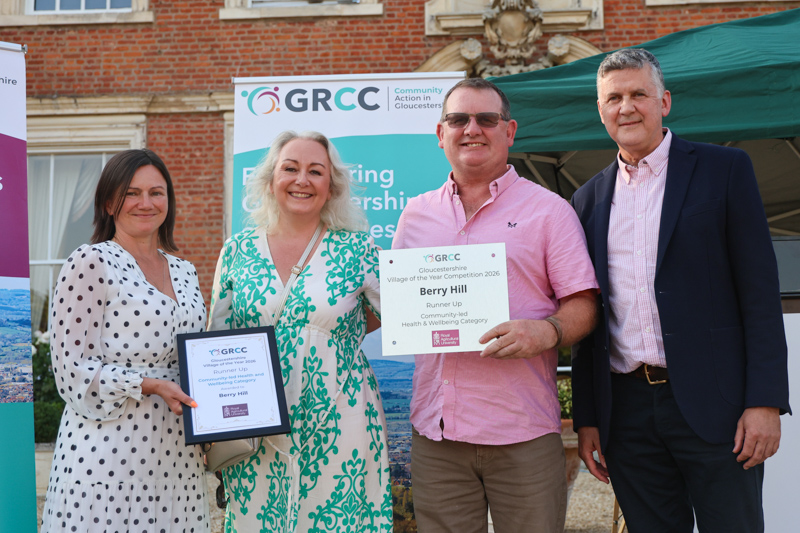
Photo above: left to right Hayley Coombs, Judge, Niki Kilroy and Jamie Elsmore, representing Berry Hill, and Will Marsh, Judge
The judges were impressed with the wide and well-established range of health, wellbeing, and social activities in Berry Hill, catering for all ages and abilities, demonstrating both formal and informal community participation, and also tackling social isolation through inclusive, community-led initiatives. Particular highlights are a long-running weekly social fitness session which provides a continuous source of funding for 60 community projects and causes from the £1 attendance fee, and the community-designed and constructed orchard with over 40 varieties of fruit trees and bushes, including heritage varieties. Maintained by volunteers, fully accessible, and providing plenty of benches, it is used for quiet contemplation, social gatherings and seasonal events, and education for the local children as well as providing fruit!
Overall, the judges came away with a sense of a community committed and focused on making their village the best it can be through activities created and led by local residents for all age groups to ensure they are accessible, relevant, and well-supported, and through coming together to develop and to save community assets.
Category 2 Climate and Environment (Resilience), sponsored by Freeman Homes.
A great deal is talked about the environment and sustainability, with the various Councils in Gloucestershire having declared Climate Emergencies. This category explored how our communities are engaging with this issue.
Winner - Painswick
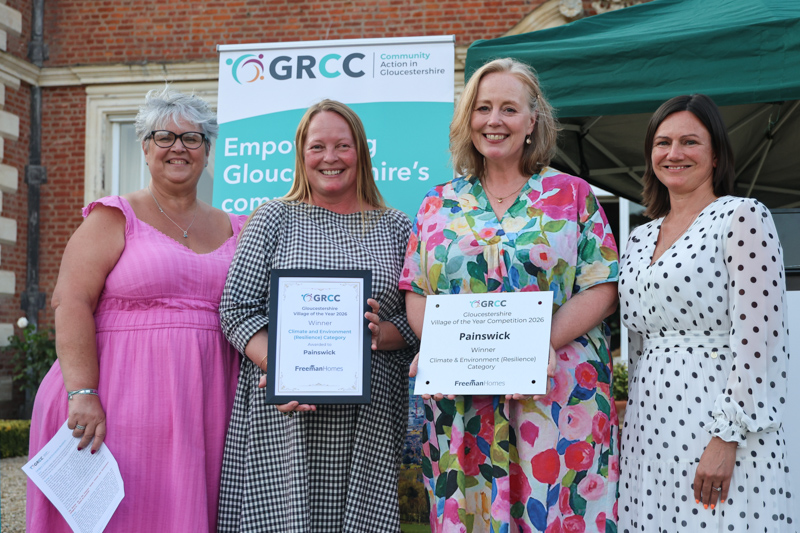
Photo above: left to right Vikki Walters, Judge, Cllr Fiona Mackenzie-Jenkin and Sandra Randle, representing Painswick, and Hayley Coombs, Judge
A long-term commitment to combining environmental stewardship with community engagement is in evidence in Painswick, which continues to develop and implement new initiatives and collaborations. The Parish Council having recently taken over management of the churchyard, additional areas for wildflower planting and rewilding have been identified here and also at the Recreation Ground. A new In Bloom initiative has been introduced in partnership with local businesses and community groups, aiming to enhance the village with colour and visual interest whilst also introducing pollinator-friendly planting. Young people and families are engaged in stewardship activities such as rewilding, path maintenance, habitat protection, and tree and wildflower planting. The strength of the community networks and organisations is key to the village’s environmental work, in particular over 40 active volunteers providing ongoing care and ecological management of its local site of special scientific interest.
The judges recognised the impressive and long-term commitment of the Conservation Group in particular to land management and biodiversity on the SSSI and also the development of new initiatives, all of which bring together people from across the community to improve their environment.
Runner-up - Upton St Leonards
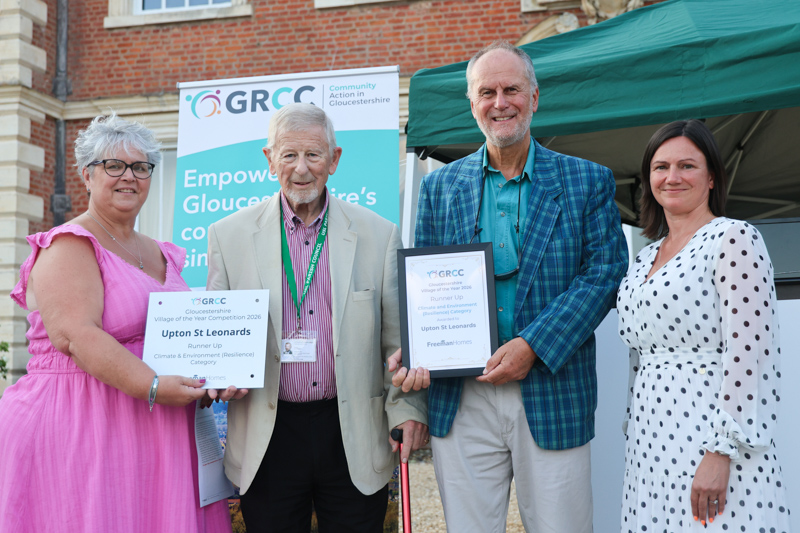
Photo above: left to right Vikki Walters, Judge, Cllr Keith Pearson and Cllr Cliff Alderman, representing Upton St Leonards, and Hayley Coombs, Judge
At the heart of this village’s engagement with the environment and sustainability is their biodiversity policy and action plan, the impact of which the judges could see for themselves on their visit. A particular achievement is the creation of stronger partnerships within the community, whether with the church over churchyard management or with the school and engaging children in environmental activities, such as planting wildflowers on a commonly used path to the school, helping plant trees at the local recreation ground, and installing bee and bug hotels. Volunteers ensure paths and public rights of way are maintained while still looking after the wildlife. Solar-powered lights have been installed on the village green, and the nature reserve on the common, regarded by the judges as particularly impressive, is managed as partly grazed grassland with a long-term aim of reintroducing a butterfly species to the area.
The judges could see that biodiversity and the environment are close to the heart of the village, and highlighted the engagement of children, via the school and through the village show, as part of the community’s long-term commitment to environmental action.
Highly Commended - Berkeley, and Bisley
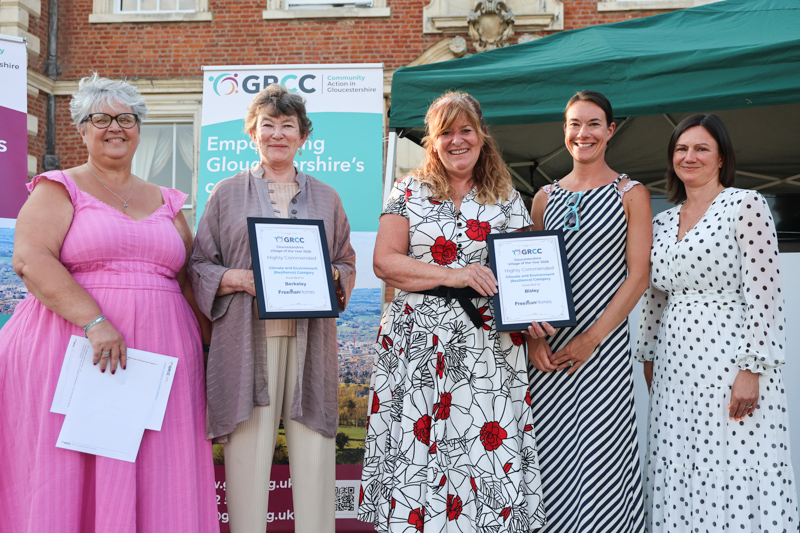
Photo above: left to right, Vikki Walters, Judge, Margaret Orchard, representing Berkeley, Catherine Jones and Kim Barber, representing Bisley, and Hayley Coombs, Judge.
The judges were keen to recognise two additional communities for their work in this category.
Berkeley impressed the judges with their grounded, resident-led and technically informed work on dealing with flood risk, where local knowledge has been converted into maps, reports, agency conversations, and practical maintenance. The group of six volunteer Flood Wardens has achieved a lot in the nine months since they started gathering evidence of issues, and the community is also in the process of updating its emergency plan and taking practical steps to build relationships with local response organisations and volunteers to help with access during a flooding event.
Bisley stood out for their strong visible evidence of the practical application of the parish council’s environmental policies. It demonstrated biodiversity support, circular economy, and local food-growing work, with its allotments, community orchard, and 21-year-old community composting scheme operating at scale and supporting the allotment holders with their no- or low-dig approaches, and the Parish Council’s pesticide-free policy. In addition to the heritage tree varieties in the community orchard there are also various encouragements and supports for local wildlife such as swift and newt boxes, slow-worm habitat, dormouse tubes, and bee-friendly planting, and recent tree and hedge planting at the recreation ground.
Category 3 Volunteering and Skills in the Community, sponsored by Gloucestershire Employment and Skills Hub
Volunteering helps strengthen communities through supporting activities and services, as well as enhancing the personal wellbeing, skills, and mental health of volunteers. It can teach new skills which can help with employment prospects, build confidence, and provide people with a sense of connection to their community. This category looked at the volunteering opportunities available in Gloucestershire’s communities.
Winner - Gretton
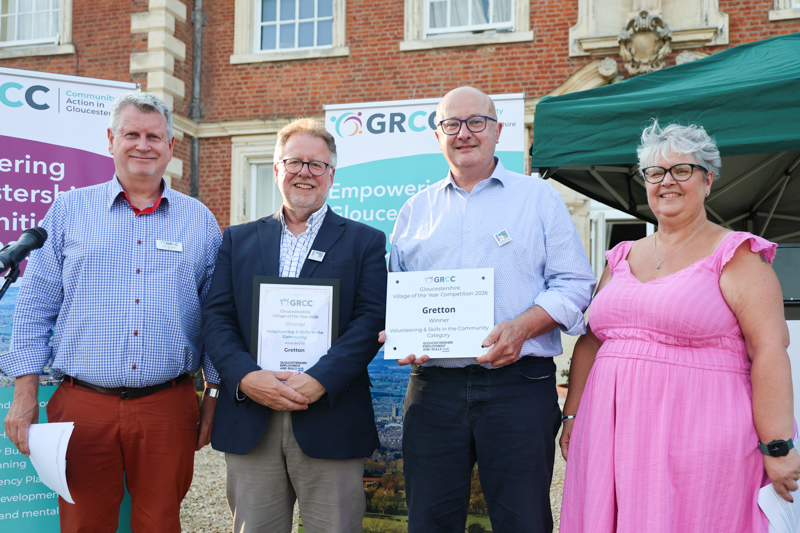
Photo above: left to right, Mike McKeown, Judge, Mark Oliver and Adam Wawn, representing Gretton, and Vikki Walkers, Judge
The judges were particularly struck by Gretton's strong volunteering culture, high levels of participation, and wide range of formal and informal opportunities in this village which has embedded volunteering in everyday life. Various community-led initiatives are available which support volunteers in learning new skills and also in improving routes to employment, such as work experience opportunities for young people, and there is evidence of meaningful intergenerational interaction through activities and events which the judges felt to be a natural and established part of village life. Involvement in community projects such as maintenance days, litter picks, and the £70k Play Equipment Project, brings people together, help build a sense of community, provide a feeling of doing good. The rebuilding of the Village Association in recent years from a team with little support to being oversubscribed and supported by a ‘helpers’ network to assist with running events, jobs, etc. shows how the right opportunities and encouragement can bring a community together to the benefit of all.
Runner-Up - Painswick
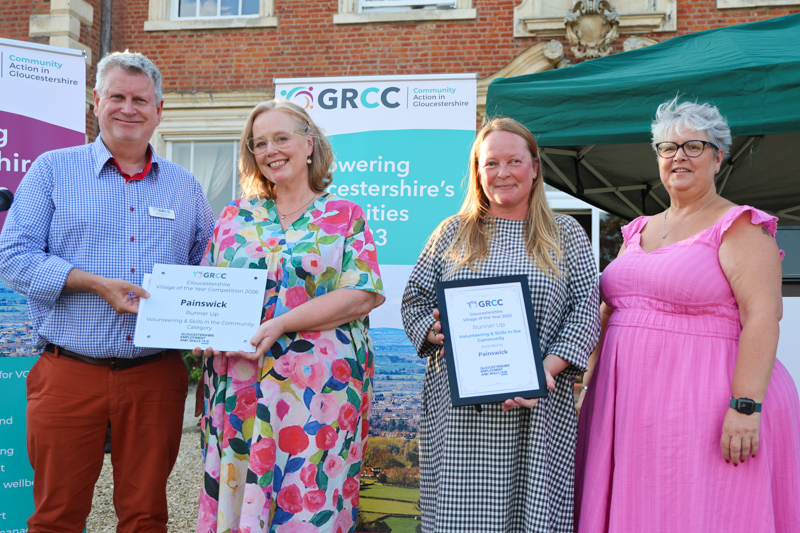
Photo above, left to right, Mike McKeown, Judge, Cllr Fiona Mackenzie-Jenkin and Sandra Randle, representing Painswick, and Vikki Walters, Judge
The judges noted the extensive opportunities for volunteering in Painswick, as evidenced by the wide range of groups, clubs, organisations, and activities on offer. From environmental activities such as the Conservation Group, local amenities such as running the community library, Community Hub, and food bank, redecorating the community centre, to sports clubs, arts and crafts, and social activities, there is an opportunity for everyone of any age to get involved. Skills sharing and even apprenticeship opportunities are available, meaning volunteering in this village not only contributes to an active community but also can help individuals improve their own employment prospects.
The judges were impressed by the range of opportunities available, and the number of people actively involved in making this a vibrant and engaged community.
Category 4 - Digital, sponsored by Cotswold, Stroud, and Tewkesbury Councils
The use of technology is changing how services are provided, how communities connect, and how individuals interact. It presents opportunities but also risks leaving behind people who are unable to use it or who lack confidence. This category is about exploring how our communities connect with their residents, support individuals to get online, and the innovative uses they make of digital.
Winner - Upton St Leonards
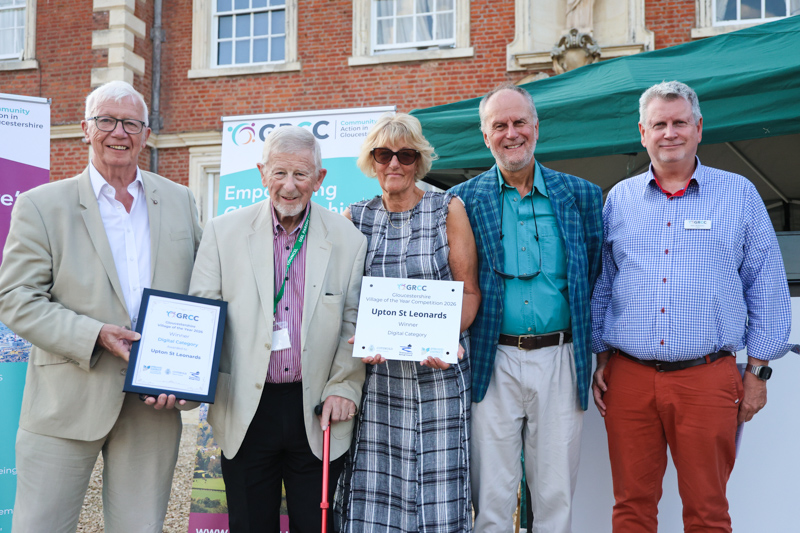
Photo above, left to right, Phil Sullivan, Judge, Cllr Keith Pearson, Chrissie Castle, and Cllr Cliff Alderman, representing Upton St Leonards, and Mike McKeown, Judge
This community has built on digital innovations and solutions resulting from Covid, balancing the website and social media with analogue communications such as the village magazine and notice boards to ensure no one is left behind. A highly successful local support group of volunteers was created to assist vulnerable residents, and this model is being reactivated as a preparedness measure for future emergencies. Free public Wi-Fi in community spaces along with informal digital training sessions and ad hoc provided by a local resident and Parish Council staff support older members of the community to get to grips with IT and not feel isolated. WhatsApp groups act as a central communication hub, keeping people connected and able to respond quickly to local needs and coordinate shared responsibilities, whether highly localised, or for wider groups. The Footpaths Group, for example, uses it to plan maintenance work and practical logistics, allowing the volunteers to work most effectively. QR codes placed around the village offer instant access to information about locations, features, points of interest, and local history, encouraging exploration and self-guided discovery.
The judges were impressed with the commitment to inclusivity and connectivity, including plans to further improve accessibility through the free Wi-Fi and additional training and support, expanding digital engagement tools, and aiming to ensure all residents are better able to participate in local life.
Runner-Up - Gretton
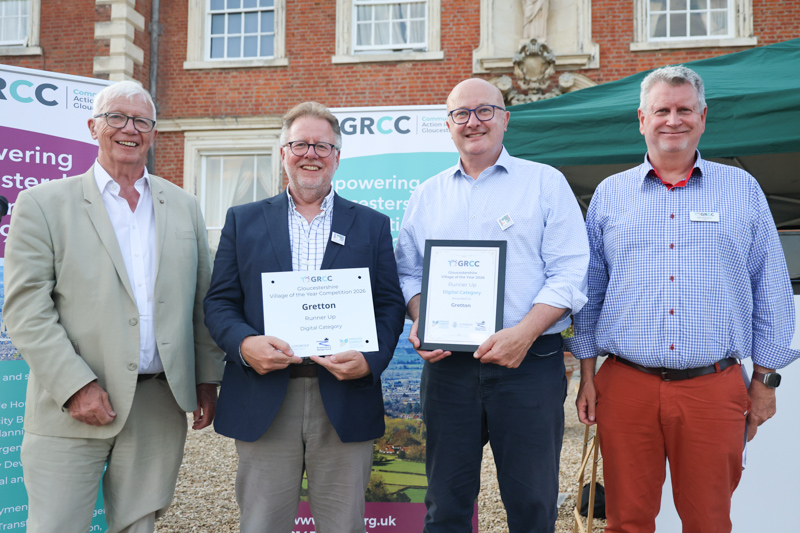
Photo above, left to right, Phil Sullivan, Judge, Mark Oliver and Adam Wawn, representing Gretton, and Mike McKeown, Judge
This small village uses a wide range of digital tools to support communication, community coordination, and day-to-day operations in a practical and meaningful way. While face-to-face and traditional engagement remain central, digital plays a complementary role via the community website, social media platforms, and WhatsApp groups, ensuring that communication is accessible to different parts of the community, supporting both engagement and awareness. Through its partnership with GRCC’s DAISI project, the community provides effective and well-established digital support for residents in a familiar social setting, meeting a genuine need in the community, while the Help Force WhatsApp group, established during Covid, remains an active means of facilitating community members to support each other. Historical records and artifacts are currently being digitised to create an online village historical archive, to eventually include records from the school and from people in the community.
The judges were impressed with the current use of digital tools to enhance community life, the clear strength in inclusion, and the determination to build on existing good foundations in a practical, sustainable way.
Highly Commended - Westbury on Severn
Photo above, left to right, Phil Sullivan, Judge, Jan D'Ambrogio and Di Landon, representing Westbury on Severn, Mike McKeown, Judge
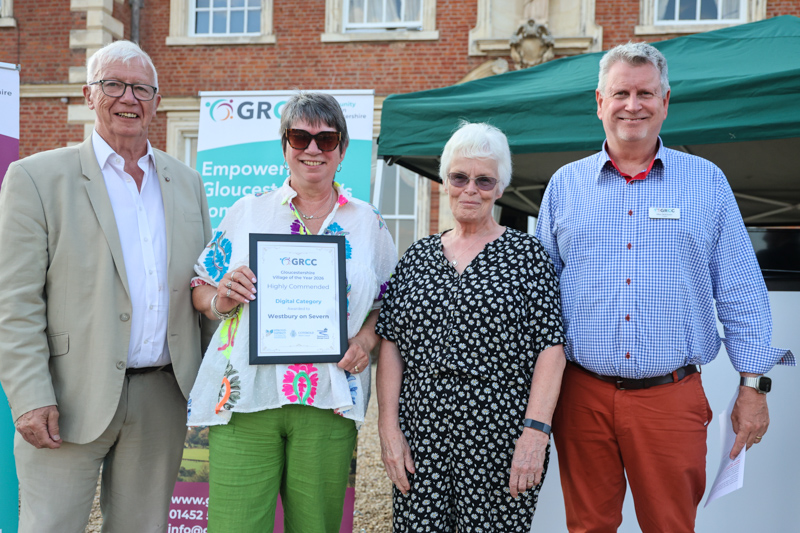
Photo above, left to right, Phil Sullivan, Judge, Jan D'Ambrogio and Di Landon, representing Westbury on Severn, Mike McKeown, Judge
The judges were keen to recognise Westbury on Severn for their enthusiasm for modern technology, exploring how it can be used, and providing opportunities for residents to access help with digital issues, mobile phones, and information on scams and online risks through partnering their monthly coffee morning with GRCC’s DAISI project. WhatsApp groups, the parish enewsletter, and social media groups help keep residents connected and informed. An innovative use has been made of AI by the theatre group for the pantomime, projecting local scenery with humorous additions to the stage backdrop. In addition, capturing information digitally, including parish council archives and the deciphering and recording of about 2,000 gravestone inscriptions by a devoted volunteer, is developing a valuable online local heritage resource.
High Sheriff’s Young Person’s Overcoming Adversity Award
This award recognises young people in our communities who have overcome challenges in their lives and how deserve recognition. The entries have been inspiring, with the nominees showing remarkable resilience, determination, and personal growth in the face of adversity. Gloucestershire High Sheriff, Dame Fiona Reynalds, chose to honour two very special young people.
Joint Winner - Nett Lord (below)
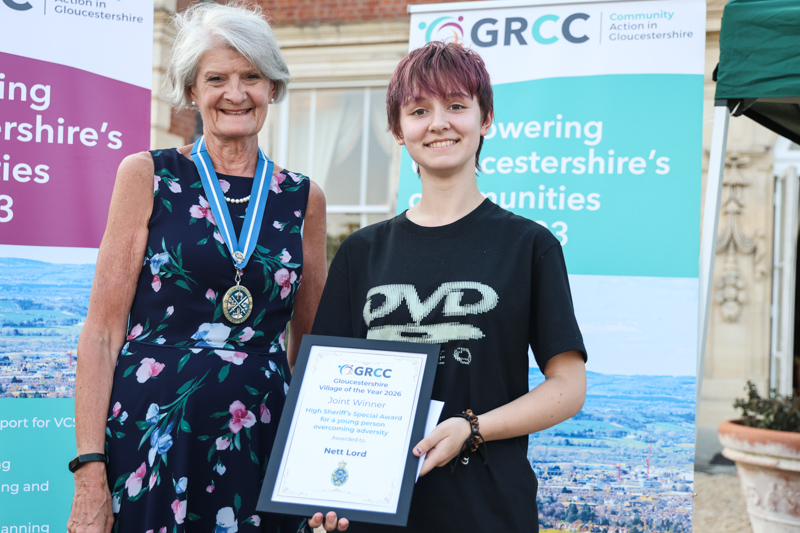
Photo above: Gloucestershire High Sheriff, Dame Fiona Reynolds, left, presents the award to Nett Lord, right.
Joint Winner - Grace Smart (below)
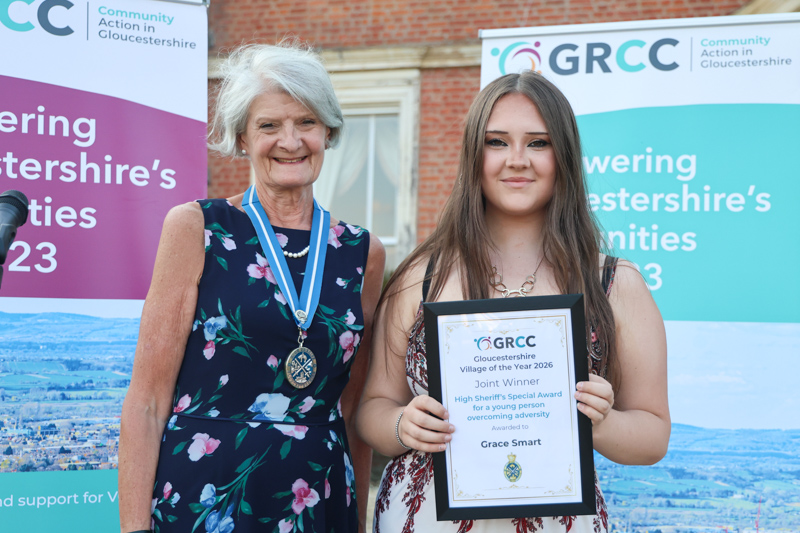
Photo above: Gloucestershire High Sheriff, Dame Fiona Reynolds, left, presents the award to Grace Smart, right.
Grand Prize Draw - Sponsored by B&Q
Winner - Berry Hill
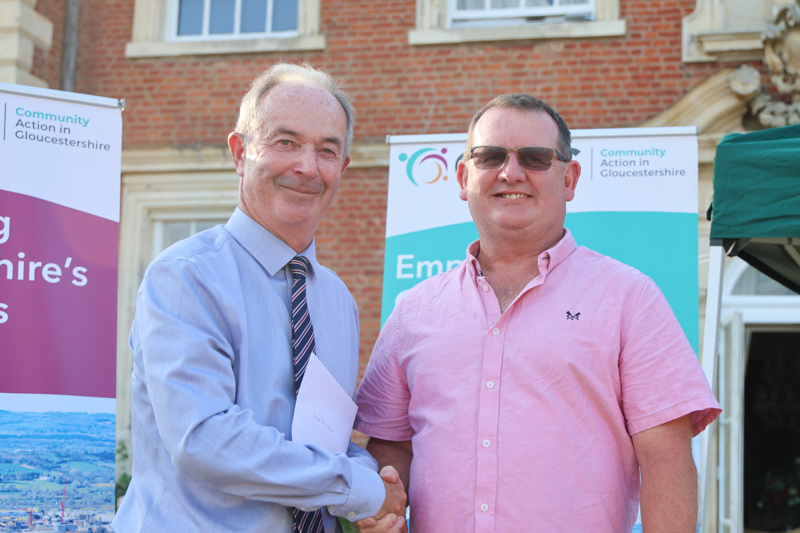
Photo above: Richard Bradley, Vice Lord-Lieutenant of Gloucestershire, left, presents the prize of £500 worth of garden equipment donated by B&Q, to Jamie Elsmore, representing Berry Hill, right.